
ICRA Style Containment
Thousand Oaks, CA

For outpatient clinics, biotechnology laboratories, and sensitive commercial facilities requiring ICRA Style Containment Thousand Oaks, CA, T-Rex Demo Worx constructs certified negative-pressure envelopes engineered to prevent particulate migration. Backed by CSLB C-21 Lic. #1155346 and vetted as an approved USC contractor, our single-source demolition, hauling, and disposal workflows keep adjacent occupied spaces completely protected.

How Does ICRA Style Containment Protect Occupied Medical & Commercial Facilities?

ICRA style containment prevents hazardous airborne dust, mold spores, and respirable crystalline silica from infiltrating occupied zones during architectural strip-outs. T-Rex Demo Worx builds airtight containment barriers utilizing heavy flame-retardant polyethylene sheeting, rigid poly panels, and spring-loaded support poles sealed from slab to structural roof deck. Transition anterooms feature magnetic zippered doorways, sticky walk-off mats, and technician gowning stations to capture tracked debris at the threshold. Inside the work envelope, commercial negative-air machines equipped with multi-stage True HEPA filters pull indoor air inward and vent scrubbed exhaust outside, maintaining a verified negative differential pressure of at least -0.02 inches of water column (in-WC) to ensure clean makeup air flows continuously toward the active demolition zone.

Our field execution combines company-owned equipment with matched commercial rentals to adapt to any healthcare or technical facility layout. We deploy owned industrial HEPA air scrubbers, high-volume negative-air machines, and calibrated digital manometers to record verifiable, time-stamped differential pressure logs throughout the project life cycle. For interior material movement, our compact 36-inch Bobcat MT100 mini track loader navigates narrow service corridors without scuffing finished commercial surfaces, while electric scissor lifts and HEPA-shrouded concrete saws are mobilized from our project-matched rental network with zero downtime.
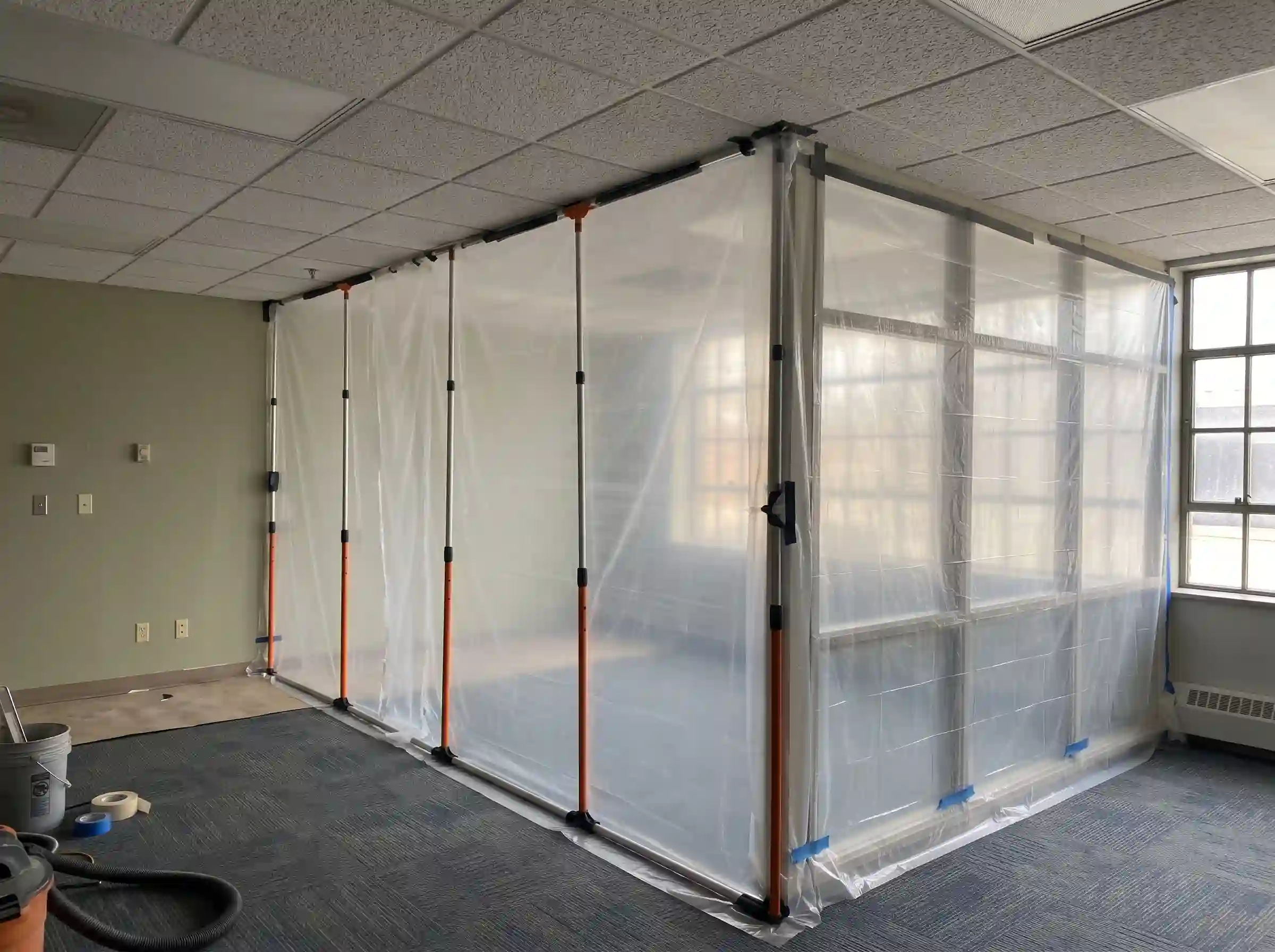

When third-party engineering, hazardous testing, or certified soil compaction are required, we coordinate directly with qualified engineers, testing agencies, and certified abatement specialists. Permit coordination is available when required to help general contractors keep municipal documentation fully compliant.
How Does ICRA Style Containment Protect Occupied Medical and Commercial Facilities

Why Are Continuous Pressure Monitoring & Sealed-Cart Egress Crucial for Clinical Integrity?

Physical dust barriers provide zero defense if negative pressure drops or loose debris contaminates shared corridors during transit. True infection control demands continuous mechanical pressure and sealed waste handling.

Digital Differential Pressure Logging

Airflow dynamics fluctuate as exterior doors open or central HVAC cycles. We equip active enclosures with digital differential manometers that measure and record real-time air pressure down to 0.001 in-WC. If pressure drops below required thresholds, audible and visual alarms notify technicians immediately. These automated logs provide verifiable audit trails for general contractors and facility safety directors, matching the clinical criteria detailed in healthcare hospital demolition.

Closed-Cart Corridor Defense & Turnkey Hauling

The highest risk of cross-contamination occurs when crews move demolition rubble through shared building hallways. All gypsum rubble, acoustical ceiling tiles, and broken flooring are loaded into heavy 6-mil plastic bags or hard-sided rolling bins directly inside the negative-pressure zone. Bin exteriors are HEPA-vacuumed and wiped down in the anteroom airlock before transit over neoprene floor runners. Operating T-Rex Express Hauling (Waste Hauler Permit PER-22-017), we transfer debris straight into our company-owned roll-off dumpsters or Chevy 7500 and Isuzu NRR dump trucks for immediate transit to state-permitted recycling centers, reflecting the surface-protection protocols we apply across selective-interior-demolition.

HVAC Mechanical Preservation

Unprotected HVAC supply and return dampers quickly pull construction particulates into building-wide circulation. Our crews physically seal all mechanical duct registers with heavy poly and foil tape, establishing dedicated exhaust routing through exterior windows or louvers so central mechanical systems remain free of fine dust.

ICRA Containment Classifications & Engineering Controls Matrix

Infection Control Risk Assessment (ICRA) guidelines require precise alignment between physical barrier integrity, airflow mechanics, and material transfer protocols to protect patient health and maintain sterile operations.

ICRA Control Level Physical Barrier Specification Air Pressure Dynamic Debris Egress Protocol Recommended Application
Class II Dust Control Standard poly partitions with taped overlapping joints Recirculating HEPA air scrubbers (6-8 ACH) Direct bagging into rolling carts with misting Minor electrical cuts, non-bearing drywall patching, ceiling access
Class III Negative Air Isolation Floor-to-ceiling sealed flame-retardant poly or modular rigid walls Continuous negative pressure (-0.01 to -0.02 in-WC) with external exhaust Sealed rolling bins wiped down in single-stage airlock Active outpatient suites, occupied office remodels, dental clinics
Class IV Clinical Containment Heavy-gauge poly or rigid interlocking panels with dual-chamber anteroom Continuous negative pressure (-0.02 in-WC min.) with digital logging Two-stage decon airlock, vacuumed carts, direct truck loading Surgical suites, R&D labs, acute care wings, multi-room strip-outs
Every ICRA containment boundary is continuously validated using digital manometers, particle counters, and daily barrier inspections to guarantee that adjacent clean environments and clinical pathways remain completely uncompromised.

4-Step Field Containment & Demolition Protocol

Our four-phase protocol guarantees predictable progress, verified negative pressure, and clear communication on every site:

Stage One

Pre-Construction Survey & Airflow Modeling

We evaluate mechanical drawings alongside your superintendent, locate central HVAC supply and return points, establish negative-air exhaust routes, and map clean transit paths to loading docks.

Stage Two

Barrier Buildout & Manometer Calibration

Technicians erect airtight poly or rigid dust barriers, build multi-stage anteroom vestibules, seal mechanical registers, and power on industrial HEPA negative-air machines. Digital manometers are calibrated to confirm steady negative differential pressure before any demolition tool is activated.

Stage Three

Dust-Controlled Strip-Out & In-Zone Packaging

Crews dismantle non-bearing walls, acoustical ceilings, and flooring using HEPA-shrouded tools and our Bobcat MT100. All rubble is sealed in heavy-duty rolling bins directly within the containment envelope.

Stage Four

Decon Cart Transit, Hauling & Final HEPA Turnover

Carts are vacuumed clean in the airlock and rolled out through protected corridors to our on-site company trucks or roll-offs. Crews perform thorough HEPA vacuum passes and damp-wiping down to bare sound framing, handing over an immaculate footprint ready for follow-on trades.

Frequently Asked Questions

Key technical answers regarding clinical barrier standards, Class IV differential pressure calibration, sealed hallway transport, and municipal plan check coordination.

Standard dust partitions consist of loose plastic hung with staples to block visible debris. ICRA style containment is an engineered mechanical envelope utilizing airtight, flame-retardant walls, multi-stage anterooms with tacky walk-off mats, continuous HEPA negative air pressure, and digital manometer monitoring. This setup forces clean air to flow inward, guaranteeing that sub-micron particulates and fungal spores cannot migrate into occupied patient rooms or clean office corridors.

ICRA Class IV standards require a minimum continuous negative differential pressure of -0.02 inches of water column (in-WC) relative to adjacent clean spaces. T-Rex Demo Worx maintains and logs this pressure using calibrated digital differential manometers, providing time-stamped compliance documentation for project managers and clinical facility inspectors.

Debris is never transported loose in open buckets or carts. All demolished drywall, insulation, and framing rubble are bagged in 6-mil plastic or loaded into hard-sided rolling bins directly inside the negative-pressure zone. Bin lids are locked, and wheels and exterior surfaces are HEPA-vacuumed and damp-wiped inside the decontamination airlock before rolling over protective floor runners to our dedicated trucks.

Yes. Permit coordination is available when required. When interior deconstruction involves structural boundaries, ceiling fire sprinkler modifications, or non-bearing partition removal down to stud bays, municipal building departments may require non-structural alteration permits. We assist general contractors and property managers by providing containment floor plans, equipment schedules, and scope narratives to keep plan check reviews on schedule.

Clinical Barrier & Estimating Desk

Request an On-Site Job Walk for ICRA Style Containment Thousand Oaks, CA

Protect clinical operations, sensitive research environments, and building occupants with licensed C-21 containment specialists. T-Rex Demo Worx delivers hospital-grade containment discipline, continuous digital manometer logging, and single-source hauling to guarantee a clean, code-compliant turnover.

Connect with our dispatch and project management desk to discuss your containment specifications or schedule an immediate job walk for ICRA Style Containment Thousand Oaks, CA:

Licensing Authority CSLB C-21 Demolition Contractor Lic. #1155346 | Waste Hauler Permit PER-22-017
Direct Channels Dispatch Phone (626) 257-3861, Online Project Inquiry, and Email via contact
Coverage Reach Prompt mobilization across Ventura, Los Angeles, and Orange Counties

Contact our field supervision desk today to review your containment specifications and receive an itemized proposal.